



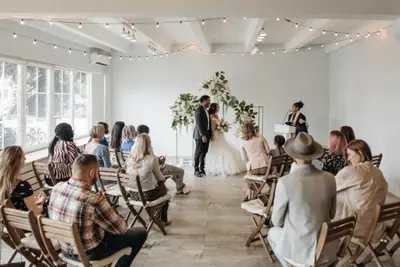


Pick the poem that fits your moment: a reading at the ceremony, a toast at the reception, or a few lines in a card. All 14 poems below are original and written for a mother to read aloud or give to her daughter. Change the names and details to match your own family.
Each poem shows its speaking time, worked out at about 130 words a minute. A poem under 90 seconds is a safe length for a mother of the bride poem. Past two minutes, guests start to shift in their seats.
Find your poem:
- To read at the ceremony or a dinner: mother of the bride poems
- For the reception: a toast in verse or a funny poem
- For a card or the morning of the wedding: short poems
- For a second-time bride, a daughter marrying a woman, a stepmother or adoptive mother, or a mother who has passed: poems for special situations
- To write your own: a five-step guide and a fill-in template
Quick guide: all 15 readings by speaking time. Tap a column heading to sort.
| # | Reading | Time |
|---|---|---|
| 1 | Before You Go | 45 sec |
| 2 | The Kitchen Table | 55 sec |
| 3 | What I Learned the Slow Way | 35 sec |
| 4 | To Both of You | 45 sec |
| 5 | A Toast in Verse | 45 sec |
| 6 | Things I Promised Not to Say | 35 sec |
| 7 | A Few Lines for a Card | 15 sec |
| 8 | For the Morning Of | 10 sec |
| 9 | Something Old, New, Borrowed, Blue | 25 sec |
| 10 | If You Will Cry Anyway | 10 sec |
| 11 | For a Second-Time Bride | 45 sec |
| 12 | For a Daughter Marrying a Woman | 50 sec |
| 13 | For the Daughter Who Became Mine | 45 sec |
| 14 | If She Could Be Here | 1 min 10 sec |
| 15 | Fill-In-the-Blanks Template | 55 sec |
Mother of the Bride Poems to Read at the Wedding
These four suit a ceremony reading, a rehearsal dinner or a quiet moment before the reception. Two rhyme and two are free verse, so you can choose whichever is easier to say out loud.
Before You Go (about 55 seconds)
I held your hand to cross the street,
then held it less, then let you go.
You walked ahead on quick, sure feet,
and I just learned to watch you grow.
Today there's someone at your side
who makes you laugh out loud, the way
you did when you were small. My pride
is bigger than the words I say.
So here is all I'll ask of you:
call me on Sundays when you can.
My door stays open. Come on through
whenever life goes off your plan.
Now go, your person's waiting there.
I'll hold the door and hold my tears.
You have my love, and you will bear
it with you through the coming years.
The Kitchen Table (about 50 seconds)
You did your homework at the kitchen table,
and later you did your whole life there:
the college forms, the first heartbreak,
the job offer, the night you called to say
you'd met someone and didn't want to jinx it.
I made tea and listened.
That table has heard every important thing you've ever said.
Today you're leaving a table I set
for one I'll see in photographs and visits,
and I'm learning it's a different kind of full.
Whatever you put on yours, I hope there's
a chair for anyone who needs one,
terrible singing while the dishes dry,
and someone across from you
who always makes you stay a little longer.
Swap the details for your own. Homework at the table might be the back steps, the car or the phone, wherever your daughter told you things.
What I Learned the Slow Way (about 40 seconds)
Say sorry first. It costs you less
than waiting out the quietness.
Say thank you for the small things, too:
the coffee made, the chores seen through.
Don't keep a score. You'll lose the game
the moment both of you do the same.
Keep one thing only yours: a book,
a walk, a friend, a long hello.
Laugh when the plans go badly wrong.
Those nights become your stories before long.
I've broken every rule I've said,
so call me when you're stuck instead.
To Both of You (about 40 seconds)
I'm not here to give her away.
I'm here to make some room, to say
there's one more chair, there's one more plate,
and you can come by, early or late.
[Name], you make her laugh out loud
in ways that make this mother proud.
I've watched you both, and here's what's clear:
she's happiest when you are near.
So here's my wish for both of you:
may every day have something new,
may someone always hold the door,
and may you love each other more.
Replace [Name] with her partner's name. It works for any partner, and you can say it facing the two of them.
A Mother of the Bride Toast in Verse
A toast works when it's short and ends with a raised glass. Hold your glass low until the last stanza, then lift it on the first line of it. Pause after the third stanza, so guests know the toast is coming.
A Toast in Verse (about 50 seconds)
Friends and family, I'll be brief
(a mother's promise, past belief).
I've known the bride her whole life through:
stubborn, funny, brave and true.
[Name], she doesn't choose in haste.
She's careful, and she's got good taste.
So when she said your name, I knew:
her face lit up, and mine did, too.
I wish you rooms with noise and light,
an argument that ends all right,
a table full of friends, and then
a quiet night to start again.
So glasses up, and join me, too:
to [Name] and [Name], and the love they grew.
May all your years be bright and long,
and may your love stay just this strong.
A Funny Mother of the Bride Poem
Humor lands best when the bride is in on the joke. Use stories she'd happily tell in front of her new in-laws, and leave out anything that makes her wince.
Things I Promised Not to Say (about 40 seconds)
I will not mention the bangs you cut yourself at six.
I will not mention the car, the curfew, or the dent.
I will not mention the boy with the band
or the night you swore you'd never get married.
(That was a long time ago, and look at you.)
I'll just say this: you were always hard to stop,
and I'm so glad you've found someone who keeps up.
Everything else stays home with the photo albums,
which I have hidden. Mostly.
Short Poems for a Card or the Morning of the Wedding
If you'd rather not speak in front of a crowd, write a short poem in a card or leave it with her on the morning of the wedding. Four lines is plenty. A handwritten card is something she can keep and reread long after the wedding.
A Few Lines for a Card (about 15 seconds)
I used to watch you sleep and wonder who you'd become.
Now I know: someone I'd choose as a friend,
even if I weren't your mother.
I'm proud of you. Be happy.
For the Morning Of (about 15 seconds)
Breathe in. The hardest part is done:
you found each other. That's the prize.
The rest is cake, and speeches, fun,
and happy tears in all our eyes.
Something Old, New, Borrowed, Blue (about 15 seconds)
Something old: my love, since day one.
Something new: the life you've just begun.
Something borrowed: [my pearls] for the day.
Something blue: the tears I can't hold at bay.
If you're lending her something, name it in the third line. A grandmother's ring, a handkerchief or a pair of earrings all work.
If You Will Cry Anyway (about 10 seconds)
I swore I'd keep my makeup dry.
I lasted till you walked on by.
So if I'm sobbing in row one,
it's love. The mascara is done.
Mother to Daughter Wedding Poems for Special Situations
Not every wedding fits the usual poem. These four are for a second marriage, a daughter marrying a woman, a stepmother or adoptive mother, and a wedding where her mother can't be there. Change anything that doesn't match your story.
For a Second-Time Bride (about 40 seconds)
You know more now than you did the first time.
You know what a good day looks like when it's ordinary,
what a kind word is worth at the end of a long week,
and what you won't put up with, which is its own gift.
You've chosen again with open eyes,
and that takes a courage I'm not sure I'd have had.
I'm not worried about this one.
I'm just glad, and proud, and watching you.
Go be happy. You've earned the ordinary days.
If children are part of the day, the blended family readings and second marriage readings pair well with this poem.
For a Daughter Marrying a Woman (about 40 seconds)
I've watched the two of you across a room.
I know that look, the one that says
"are you okay?" and "I'm okay" in the same second.
It took me years to learn that, and you two already have it.
[Name], I never pictured a particular person.
I only pictured her happy, and heard,
and loving someone back with her whole heart.
You're the proof I got what I wanted.
Welcome. There's a seat for you at my table.
Look after each other. I'll keep the tea on.
Nothing in this poem needs explaining to the room, and you don't need to introduce it. More options are on the page of readings for two brides or two grooms.
For the Daughter Who Became Mine (about 40 seconds)
I didn't get the first years.
I got the middle, and I got today,
and I wouldn't trade them.
You let me in slowly, a little more each year,
and I never wanted to rush you.
I won't say I'm your mother the way the word is usually meant.
I'll say I'm yours in the way that counts:
the one who shows up, who keeps your secrets,
who has a seat saved right here.
Whatever we're called, I'm proud to stand beside you.
This one suits a stepmother, an adoptive mother or a foster mother. For more, see the stepmother to stepdaughter wedding poems.
If She Could Be Here (about 55 seconds)
She'd be in the front row early,
checking your hem, pretending she wasn't.
She'd have a tissue in her sleeve
and a joke ready for when she needed it.
She'd say your name the way only she could say it.
She isn't in the front row. She's in the way you laugh,
in the recipe you still get slightly wrong,
in every time you reach for the phone to tell her something.
She raised you to be brave and a little stubborn,
and you're both today, in front of all of us.
So we'll save her seat and cry on her behalf.
She'd want you to know she's proud, and she isn't worried.
Go be happy. That was always the plan.
This poem is for a close relative or friend to read, such as an aunt, a sister, a grandparent or her father. Don't present it as her mother's own words unless her mother wrote it. Introduce it with something simple like "These words are for your mom."
How To Write Your Own Mother to Daughter Wedding Poem
A poem in your own words will mean more to her than any example. You don't need to be a poet. You need one true memory and a few honest sentences.
- Start with one memory. A specific moment beats a general feeling. "You asked me to leave the hall light on until you were twelve" says more than "you were a lovely child."
- Say what you see in her now. Write down two or three things you admire about the woman she's become.
- Say what you see in the two of them. What does she look like when her partner walks into the room? Use that.
- Make one wish. One wish is stronger than ten. Choose the one you most want her to have.
- End with love and let her go. Finish on a short line she can hold on to. Cut anything that doesn't fit.
Fill-In-the-Blanks Template
When you were [age], you [memory].
I remember [small detail] and thinking [thought].
You've always been [quality] and [quality],
and today I see [what she looks like around her partner].
[Partner's name] makes you [feeling],
and that's all I ever wanted for you.
My wish for you both is [wish],
and [second wish], and [third wish].
Whatever happens, [promise from you].
I love you. Go and be happy.
A rhyme is optional. Free verse is easier to read aloud and less likely to sound forced. If you do rhyme, read it aloud as you write, and drop any line where the rhyme is steering the meaning. When you're stuck, remember that a plain sentence said sincerely beats a clever line that doesn't sound like you.
How To Read a Poem at a Wedding
At about 130 words a minute, these are the lengths to aim for:
- 50 words: about 25 seconds, ideal for a card or a quick moment
- 100 words: about 45 seconds, a comfortable ceremony or dinner reading
- 150 words: about 70 seconds, the upper end for a toast
- 200 words: about 90 seconds, the longest most guests will sit through
- Print it in large type. Twelve to sixteen points, double spaced, on one page. Your hands may shake.
- Read it aloud five times. Do it once alone, once to a mirror and once to someone who loves you.
- Mark the pauses. A slash at each line end or stanza break reminds you to breathe.
- Slow down. Nerves speed everyone up, so read slower than feels natural.
- Have a backup. Give a copy to a sister, a friend or the officiant, and agree that they'll step in if you can't finish.
- Use the microphone. Hold it near your chin, not your chest, and test it before the guests arrive.
- Bring tissues. And take a moment of quiet before you start.
Ask the officiant where a mother's poem can go in the ceremony, and for how long. A mother's poem often goes before the vows or after another reading, but the officiant decides. Church weddings often require that every text be approved, and some only allow scripture, so check early. If you need an approved option, see the Catholic wedding readings. For a civil ceremony, the non-religious wedding readings and short wedding readings may suit too.
What To Avoid in a Mother of the Bride Poem
- Stories that embarrass her in front of her partner's family, such as old boyfriends, diets or fights.
- Advice that sounds like a warning, such as "marriage is hard work" or "don't let him..."
- Comparing her partner to an ex or to someone she loved before.
- Making the poem about you. A line or two about your feelings is lovely. A whole stanza of your sadness is heavy.
- Going past two minutes. Cut a stanza before you add one.
- Rhymes that force the meaning. If a word is only there for the rhyme, change the line.
Ways To Give the Poem to Your Daughter
- Handwrite it on good paper and put it in a frame she can hang after the wedding.
- Slip it into a card on the morning of the wedding, with the short poem on the outside and a few lines inside.
- Pair it with a small keepsake, such as a piece of jewelry, a handkerchief or a locket, in a box tied with ribbon.
- Record yourself reading it on your phone and send the file to her before the day, so she can listen to it alone.
- Read it, then hand her the page. The paper is something she can keep when the moment has passed.
More Wedding Poems From the Family
Other family members may want a poem of their own. See the father to daughter wedding poems, the sister to sister wedding poems, the grandmother to granddaughter wedding poems, the aunt to niece wedding poems and the godmother to goddaughter wedding poems. If you're also the mother of a son, the mother to son wedding poems and the mother of the groom songs cover the other side.
Related reading: Planning the dance as well? See the best wedding entrance songs for parents, or the father to daughter wedding poems for the other parent.
Frequently Asked Questions
How long should a mother of the bride poem be?
Aim for 30 to 90 seconds, which is roughly 65 to 200 words at a calm speaking pace of about 130 words a minute. A ceremony reading can sit near the top of that range. A toast at the reception is better kept under 90 seconds.
Where can a mother read a poem at the wedding?
Common spots are the ceremony (usually before the vows or between readings), the rehearsal dinner, the reception as a toast, or privately on the morning of the wedding. Ask the officiant first, since some church ceremonies only allow approved texts.
Can I read a poem I didn't write?
Yes. If you're reading from a published poem, name the poet when you introduce it and in the program, and check the rights before you print or film it. The poems on this page are written for a mother to read or give at a wedding, so you can use them and change the details to fit your family.
What if I get too emotional to finish?
Practice aloud until the words feel familiar, choose a shorter poem, pause and breathe at each stanza, and keep the printed page in your hand. Ask a sister, a friend or the officiant to stand by and take over if you can't finish. Guests will wait.
Does a mother to daughter wedding poem have to rhyme?
No. Free verse is often easier to deliver and sounds more natural. If you want to rhyme, read it aloud as you write and change any line where the rhyme forces an awkward phrase.
What can I write in my daughter's wedding card?
Four lines is enough. Name one specific memory, say what you see in her now, and end with a wish. The short poems on this page can be copied into a card as they are or adapted.
Can someone read a poem for a mother who has passed?
Yes. A close relative or friend can read it, such as an aunt, a sister, a grandparent or her father. Introduce it as words for her mother, and avoid presenting it as written by her mother unless she did write it. A letter or a recording from her mother, if one exists, is a lovely alternative.
Is there a poem for a daughter marrying a woman?
Yes. The poem "For a Daughter Marrying a Woman" on this page is written for that wedding, and the mother-to-daughter poems here can be adapted by changing the pronouns and names. You don't need to explain it to the room.
Final Thoughts
A poem from a mother to her daughter doesn't need to be perfect. It needs to sound like you, and it needs to be short enough to say without losing your voice.
Pick one poem, change a line or two so it fits your family, read it aloud a few times, and give her a copy. She'll keep it.